 21 Days
From Casablanca
21-Day Ultimate Morocco Expedition from Casablanca
Three weeks and the whole country: every desert, city and coast.
from€1499 /person
View tour
The full loop of the country — north, desert, mountains and coast.
The full loop of the country — north, desert, mountains and coast. This 17-day private journey begins in Casablanca and is designed to give you the best of the route without the rush — with hand-picked accommodation, an English-speaking driver-guide and plenty of freedom to stop wherever catches your eye.
Highlights include imperial cities & chefchaouen, erg chebbi & erg chigaga, atlantic coast & marrakech. Like every Edita itinerary it is fully flexible: we can lengthen or shorten it, upgrade your riads and desert camp, or change the start and finish cities to fit your flights.
Keep exploring: Morocco Tours from Casablanca · all 39 Morocco tours · First-Timer's Complete Guide to Morocco
Today we take in two very different faces of modern Morocco along the Atlantic. In Casablanca, the country's largest city, the highlight is the magnificent Hassan II Mosque, one of the largest in the world, its minaret rising more than 200 metres above the ocean and part of it built out over the water — the vast courtyards and intricate craftsmanship are unforgettable, and non-Muslims can visit inside on a guided tour. We then drive north to Rabat, the elegant, easygoing capital, to explore the Kasbah of the Udayas, a blue-and-white walled quarter above the river, the towering Hassan Tower and the beautiful Mausoleum of Mohammed V, and the tranquil ruins of the Chellah. It is a gentle, cultured start to the journey before we head into the mountains and desert.
Leaving the Atlantic capital behind, we head inland and north toward the Rif Mountains and the enchanting town of Chefchaouen. The drive takes us across rolling farmland and up into greener, hillier country than many expect of Morocco, with the mountains rising ahead. On arrival, Chefchaouen reveals its magic: an entire medina painted in blue, from pale sky-wash to deep indigo, spilling down the hillside in a tangle of stepped lanes, archways and flower-filled corners. The afternoon is free to wander and photograph at leisure, to browse the wool weavings and handicrafts for which the town is known, and to sip mint tea in a shaded plaza beneath the kasbah walls. For a memorable finish, climb to the Spanish Mosque viewpoint above the town to watch the sun set over the blue rooftops.
Leaving the blue mountains behind, we drive south across rolling farmland toward the imperial heartland of Morocco, breaking the journey with two of the country's great historic sites. First we stop at Volubilis, the best-preserved Roman ruins in Morocco, where standing arches, columns and remarkably intact floor mosaics of Bacchus, Orpheus and the seasons spread across a hillside of olive groves. Nearby lies Moulay Idriss, the whitewashed holy town cascading over two hills. We continue to Meknes, the 17th-century capital of Sultan Moulay Ismail, to admire the monumental Bab Mansour gate, the vast granaries and royal stables. By late afternoon we reach Fez and check in to a riad within the old medina, leaving the evening free to rest before tomorrow's full day exploring the labyrinthine heart of the city.
Today we dive into Fez el-Bali, the largest living medieval medina in the world and a UNESCO treasure of some 9,000 lanes where donkeys and handcarts still do the work of trucks. With a licensed local guide we thread through the maze to its landmarks: the Chouara tanneries, where leather is still soaked and dyed by hand in honeycombs of stone vats exactly as it was a thousand years ago; the Al-Qarawiyyin, founded in 859 and recognised as the oldest continually operating university on earth; and the exquisitely tiled Bou Inania and Al-Attarine madrasas. We visit the coppersmiths hammering in their square, weavers at their looms and the fragrant spice souks. It is an intense, unforgettable immersion, and your guide makes sense of the beautiful chaos at every turn.
An excursion west from Fez to two of Morocco's most rewarding historical sites, both within easy reach for a full day out. We begin at Volubilis, the finest Roman ruins in the country, where a whole city of arches, columns, a triumphal gate and astonishingly well-preserved floor mosaics stands among olive groves with the fertile plains rolling away below. From there we visit the sacred hilltown of Moulay Idriss Zerhoun, birthplace of the Moroccan state and a place of pilgrimage, its green-tiled roofs spilling down the slopes. Finally we reach Meknes, the grand 17th-century imperial capital of Sultan Moulay Ismail, with its enormous Bab Mansour gateway, ramparts, royal granaries and the vast Heri es-Souani stables. By late afternoon we return to Fez, the deep layers of Morocco's history freshly brought to life.
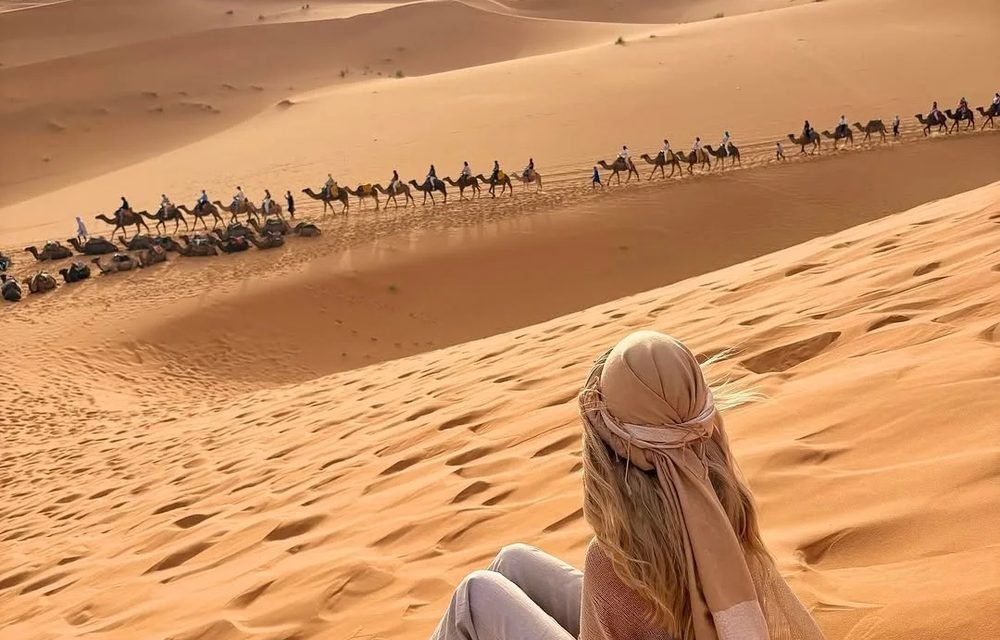
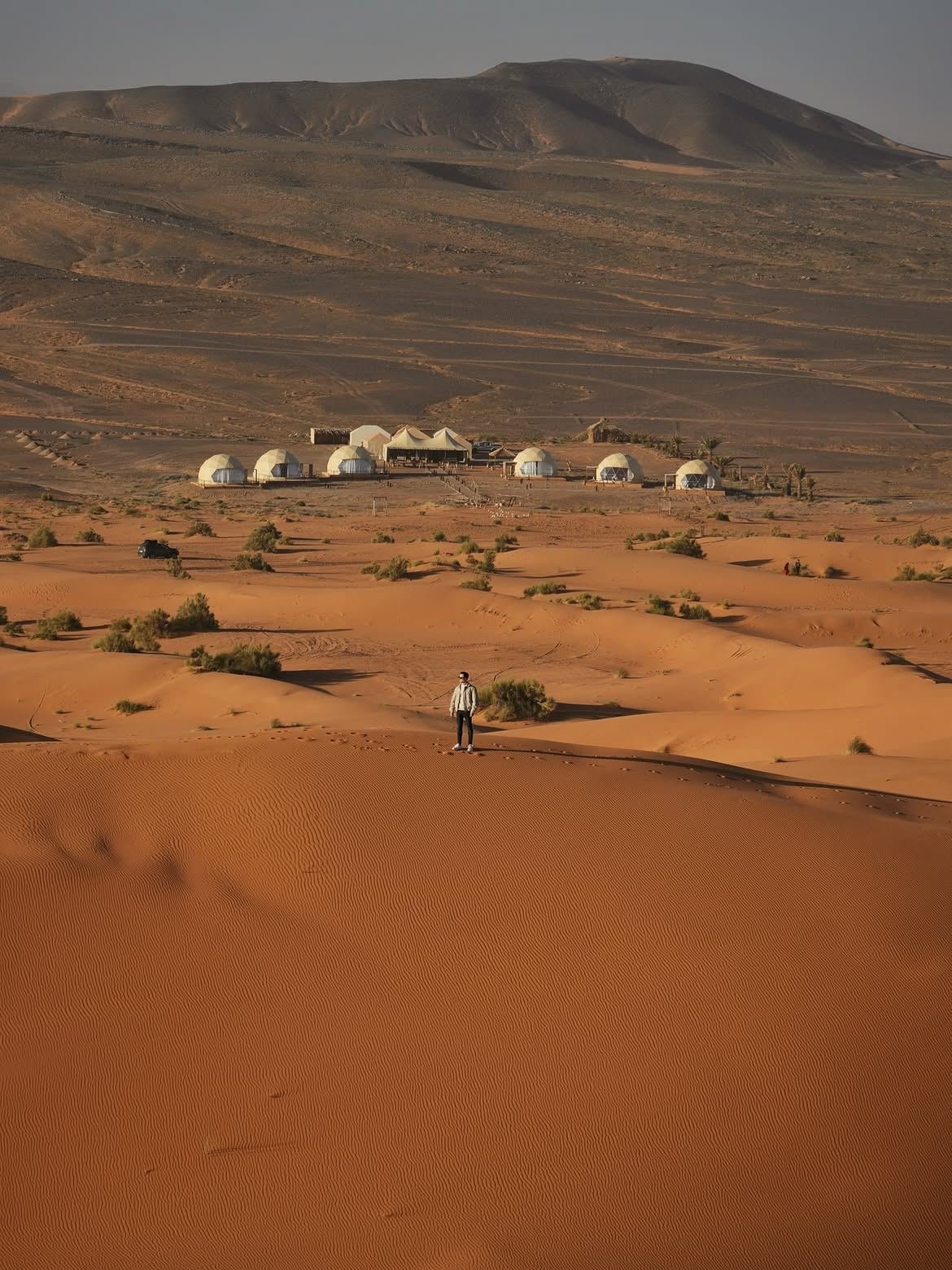
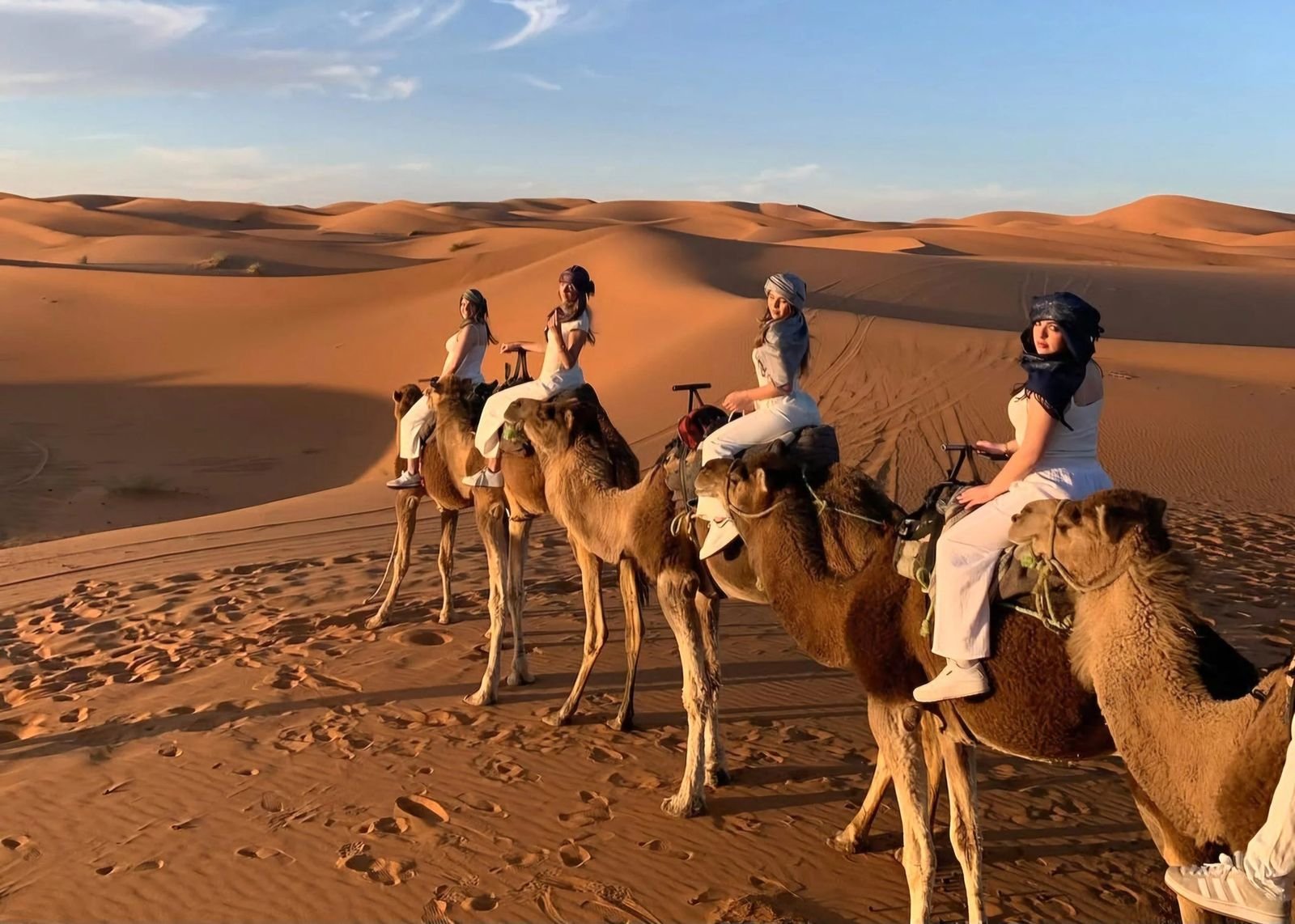
One of the great road days in Morocco, carrying us from the medieval north to the edge of the Sahara across ever-changing landscapes. We climb into the Middle Atlas to Ifrane, a curiously alpine town of pitched roofs and gardens nicknamed 'little Switzerland', then into the cedar forests around Azrou where troops of wild Barbary macaques gather at the roadside. Beyond Midelt the mountains give way to the dramatic gorges and endless palm groves of the Ziz Valley, a ribbon of green threading through bare desert rock. By late afternoon the first dunes of Erg Chebbi appear on the horizon. We swap the vehicle for camels and ride out over the sand as the light turns molten, reaching a Berber camp for tea, dinner and drumming beneath a blaze of stars.
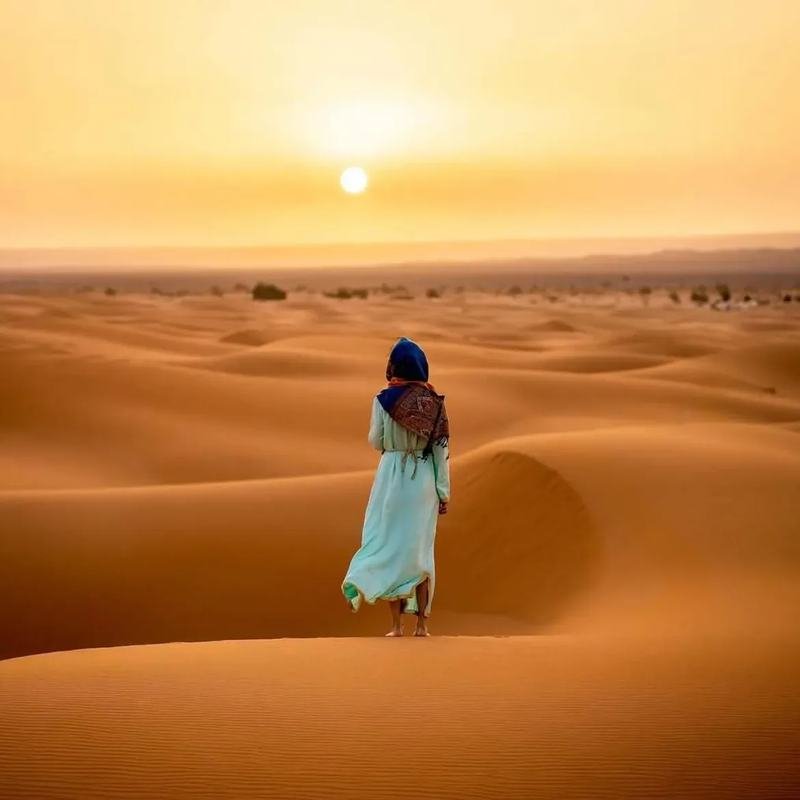
A full, unhurried day in the heart of the Sahara at Erg Chebbi, Morocco's most spectacular sea of dunes, some rising 150 metres from the plain. You can begin by climbing a high ridge for sunrise, when the sand shifts through pink, gold and deep orange. Later we explore deeper by 4x4: a visit to the village of Khamlia to hear the hypnotic Gnawa music of its Saharan community, calls on nomad families who still live by their herds, stops at desert wells and fossil-strewn flats, and a look at the old routes once walked by camel caravans. There is time to rest in the shade, try sandboarding, or simply sit with the immense silence. As evening returns you ride out once more to camp for a second magical night under the stars.
We wake early, while the air is still cool, to climb a dune and watch the sun rise over the Erg Chebbi — a slow, silent spectacle as the sand ignites from grey to rose to burning gold and long blue shadows stretch across the ridges. After breakfast at camp we explore the desert more deeply by 4x4, discovering the corners most visitors never see: hidden wells and oasis pockets, black volcanic outcrops and beds of marine fossils that prove this was once an ocean floor, and the little village of Khamlia with its Gnawa musicians. We meet nomad families at their tents over mint tea and learn how life is lived out here. There is time for sandboarding down the slopes before we return to camp or continue on toward the kasbahs.
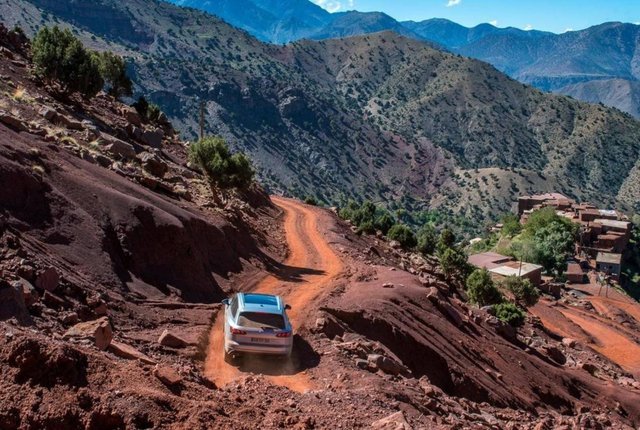
Leaving the great dunes behind, we set off west along the fabled Road of a Thousand Kasbahs. First we pause in Rissani, the market town built on the ruins of Sijilmassa, once a wealthy caravan capital at the gateway to the Sahara, and pass through Erfoud, centre of the date and fossil trade. The route then climbs into the Atlas foothills to the magnificent Todra Gorge, where sheer rose-coloured limestone walls soar 300 metres and close to just a few metres apart above a clear river — we walk a stretch on foot, dwarfed by the cliffs. Continuing through Tinghir's palm oasis and a string of earthen ksour, we reach the Dades Valley in the late afternoon, checking in near the dramatic gorge with its famous switchback road for the night.
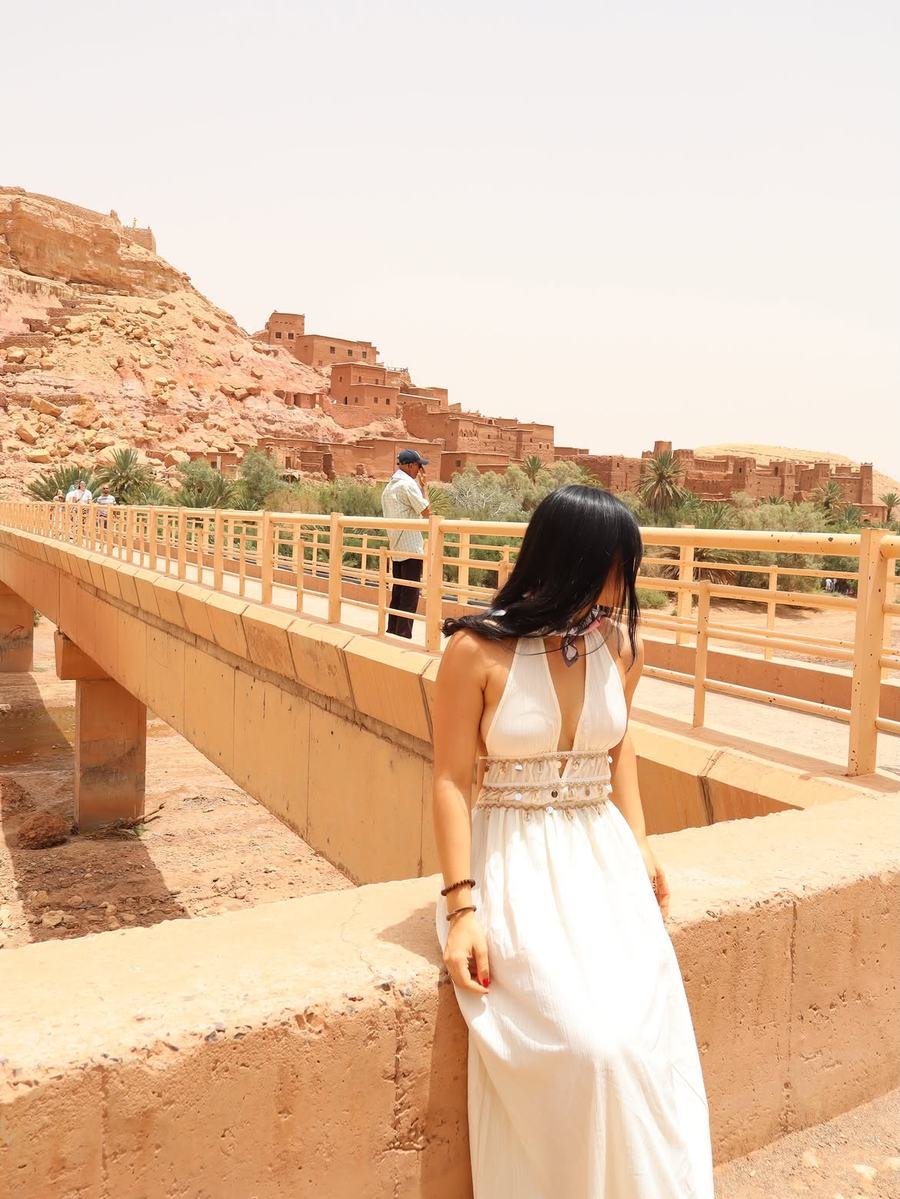
A gentler, more leisurely stage that lets us savour the highlights between the gorges and Marrakech rather than rushing past them. From the Dades Valley we drive back down through the Skoura oasis, stopping at the beautifully restored Kasbah Amerhidil, one of the largest earthen fortresses in Morocco and a wonderful place to understand how these mud-brick strongholds were built and lived in. We continue to Ouarzazate to visit the Taourirt Kasbah and, for film buffs, the famous Atlas Studios where much of Hollywood's desert cinema is made. The day ends at Ait Ben Haddou, the storied UNESCO ksar, where we stay nearby so you can wander its car-free lanes and climb to the hilltop granary at golden hour — enjoying this magical place in soft evening light, long after the day-trip crowds have gone.
After a relaxed start we take a final walk through Ait Ben Haddou in the fresh morning light, crossing the river to explore the honey-coloured towers, alleyways and kasbahs of this remarkable fortified village before the tour buses arrive. From here the road turns north for the great mountain crossing of the day: the Tizi n'Tichka, the highest major pass in Morocco at over 2,200 metres, which snakes up through the High Atlas past terraced Berber villages, walnut groves and viewpoints that seem to reach forever. We stop for photographs and perhaps a mint tea at a mountain cafe where argan oil and local honey are sold. Descending the far side, the landscape softens into the Haouz plain and we arrive in Marrakech in the afternoon, with time to relax before the evening.
A full day exploring the Red City with your guide, uncovering the monuments and hidden corners behind the bustle. We visit the iconic Koutoubia minaret, the 12th-century tower that is Marrakech's symbol, then the sumptuous Bahia Palace with its painted ceilings and tranquil courtyards, and the Saadian Tombs, a royal necropolis of exquisite tilework rediscovered only a century ago. We step into the Ben Youssef Madrasa, once North Africa's largest Quranic school and a masterpiece of carved cedar and zellige, and wander the souks quarter by quarter — dyers, metalworkers, leather and spices. As evening falls we arrive at Jemaa el-Fnaa, the great square that transforms into open-air theatre: storytellers, snake charmers, musicians, henna artists and a hundred smoking food stalls. Few places on earth feel so vividly alive after dark.
Today we set out for the wildest desert in Morocco, and it is a long, rewarding drive. We cross the High Atlas by the Tizi n'Tichka pass, stop at the great UNESCO ksar of Ait Ben Haddou, and pass through Ouarzazate before descending into the Draa Valley, whose endless palm groves and kasbahs line the route south. Beyond Zagora we reach M'hamid, the last village before the sands, where the tarmac simply ends. Here we transfer to 4x4 and strike out across open desert — flat gravel plains, dry lake beds and lonely acacia trees — for around two hours until the immense dunes of Erg Chigaga rise ahead, some of the tallest in the country. Far from any road or village, we reach a wilderness camp for dinner and a night of extraordinary silence and stars.
A full day deep in Erg Chigaga, the largest and most remote dune field in Morocco — a place so far from any road that its silence and star-filled skies are unlike anywhere else. Unhurried, we explore by 4x4 and on foot: climbing the highest dunes for views over a sea of sand stretching to the horizon, visiting nomad families who still graze their camels out here, and stopping at desert wells and the sparse oasis vegetation that clings to life between the crests. There is time for sandboarding down the slopes, for tea in the shade, and simply for sitting with the vastness. As the sun sinks we watch the dunes glow and the first stars appear, then return to our wilderness camp for a tagine dinner and an unforgettable night under the Milky Way.
We leave the deep desert behind this morning, driving out of Erg Chigaga by 4x4 across the open plains before rejoining the road and turning west toward the Atlantic side of the country. The route runs through the arid ranges of the Anti-Atlas, a landscape of ochre mountains, dry valleys and Berber villages where argan trees begin to appear, following the old trade paths that once linked the Sahara to the coast. It is a day of big, changing scenery and few other travellers. By late afternoon we reach Taroudant, a handsome market town sometimes called the 'grandmother of Marrakech', encircled by magnificent red-earth ramparts and set amid the fertile Souss Valley. We check in within its walls, leaving time to stroll the relaxed Berber and Arab souks before dinner.
A short and easy drive this morning brings us from the ramparts of Taroudant down the Souss Valley to the Atlantic coast at Agadir, Morocco's premier beach resort. Rebuilt in modern style after an earthquake in 1960, Agadir is all about relaxation: a huge crescent of golden sand stretches for kilometres along a sunny, sheltered bay, backed by a palm-lined promenade of cafes and restaurants. After the mountains and desert of the previous days, the afternoon is yours to unwind — swim in the ocean, stroll the seafront, ride a camel or horse along the beach at sunset, or simply do nothing at all with your toes in the sand. For the more active, the marina, the kasbah viewpoint above the bay and the lively Souk el-Had are all close at hand.
Your Moroccan adventure draws to a close today with a comfortable transfer from Marrakech to Casablanca, roughly three hours by road across the open plains. If your flight schedule allows, we can make the most of the morning with a stop in Casablanca to see the spectacular Hassan II Mosque, whose minaret towers over the Atlantic and part of whose vast prayer hall is built out over the sea — a fitting final image of the country. From there we deliver you to Mohammed V International Airport in good time for your onward flight, or to a hotel if you are staying a final night. We say goodbye with a warm Moroccan farewell — b'slama — and the hope that the dunes, kasbahs and mountains of these days stay with you long after you fly home.


“Impeccably organised and completely private. We changed the plan twice and Edita made it effortless. The Sahara sunrise was unforgettable.”
“From Fez to Marrakech we saw a side of Morocco most tourists miss. Comfortable 4x4, wonderful riads and a driver who knew every hidden spot.”
21 Days
Three weeks and the whole country: every desert, city and coast.
 12 Days
Imperial cities, the blue city, the Sahara and the coast in one loop.
 10 Days
Cities, the Sahara and the Atlantic on a grand loop from Casablanca.